
Why CFTC and NFA Regulation Matters
If there is one golden rule for US forex traders, it is this: never deposit your money with an offshore, unregulated broker.
The internet is flooded with offshore brokers promising massive leverage (sometimes up to 500:1), no restrictions on hedging, and the ability to fund accounts using credit cards or cryptocurrency. While these offers might seem tempting, they come with extreme risk. When you trade with an unregulated entity, your funds are not protected. If the broker goes bankrupt or simply decides to shut down its servers, your money is gone, and you have absolutely no legal recourse.
In contrast, brokers regulated by the CFTC and NFA are subject to some of the most rigorous financial standards in the world. They must maintain a massive amount of operating capital (minimum $20 million) to ensure they can weather market volatility without going belly-up. They are also subject to surprise audits, strict reporting requirements, and hefty fines for any misconduct.
Furthermore, US regulation enforces specific trading parameters designed to protect retail investors:
• Leverage Limits: The maximum leverage for retail forex traders in the US is capped at 50:1 for major currency pairs (like EUR/USD and USD/JPY) and 20:1 for minor and exotic pairs. This prevents traders from taking on catastrophic levels of risk.
• The FIFO Rule: The “First In, First Out” rule mandates that if you have multiple open positions in the same currency pair of the same size, you must close the oldest position first.
• No Hedging: US regulations do not allow retail traders to hold both long and short positions simultaneously in the same currency pair.
• Credit Card Bans: To prevent traders from going into debt to trade the markets, US brokers cannot accept credit card deposits.
While some traders view these rules as restrictive, they were implemented for a reason: to keep the industry clean, fair, and secure. Trading with a CFTC/NFA-regulated broker gives you peace of mind. You know your funds are segregated from the broker’s operating capital, and you know the broker is held accountable by strict federal oversight.
Top 5 Best Regulated US Forex Brokers in 2026
Let’s dive into the detailed reviews of the premier forex brokers available to US residents today. We have evaluated these brokers based on their pricing, platform technology, customer support, and overall trustworthiness.
1. tastyfx (formerly IG US) – Best Overall Forex Broker
tastyfx (operating as IG Group’s dedicated brand for US forex traders) easily takes the top spot in 2026. Backed by the global powerhouse IG Group—which is publicly traded on the London Stock Exchange and regulated in multiple Tier-1 jurisdictions worldwide—tastyfx offers an unparalleled combination of platform depth, competitive pricing, and institutional-grade reliability.
Platform and Tools:
What sets tastyfx apart is its incredible platform suite. Traders are not forced into a one-size-fits-all solution. You can choose from their proprietary web platform (which is lightning fast and highly intuitive), MetaTrader 4, MetaTrader 5, TradingView, and ProRealTime. The mobile app is equally impressive, featuring interactive charts where you can drag and drop stop-loss and take-profit levels directly on the candlestick charts.
Pricing:
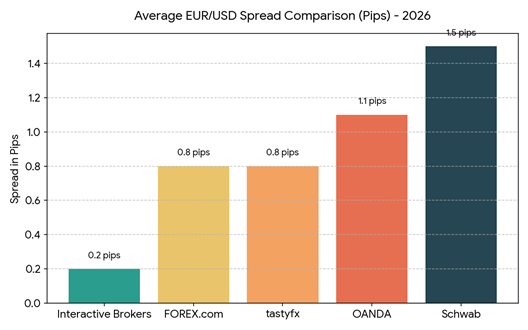
tastyfx offers a standard spread-only account that is highly competitive, with EUR/USD spreads averaging around 0.8 pips. For active, high-volume traders, they offer a “Zero+” account that provides raw, ultra-tight spreads coupled with a commission of $5 per standard lot per side. This dual-structure ensures that both occasional swing traders and aggressive scalpers can find a cost-effective pricing model.
Tradable Assets:
Because of US regulatory restrictions, tastyfx focuses exclusively on spot forex for retail clients. However, they offer a staggering 85 currency pairs. This includes all the majors, minors, and a massive selection of emerging market exotics, giving you plenty of opportunities to find volatility in any macroeconomic environment.
Verdict:
If you want a broker that does everything well—from education and research to seamless execution and platform stability—tastyfx is the undisputed leader for US traders right now.
2. FOREX.com – Best for Platform Choice and Research
FOREX.com, a subsidiary of the massive StoneX Group, is an absolute titan in the retail forex industry. Having been in the business for over two decades, they have refined their offering to cater to both new traders and seasoned veterans.
Technology and Analytics:
One of FOREX.com’s biggest selling points is its native integration with TradingView. You can connect your FOREX.com account directly to the TradingView interface, allowing you to execute trades seamlessly while utilizing TradingView’s industry-leading charting tools and social community. Additionally, FOREX.com offers MetaTrader 4 and MetaTrader 5, alongside their own proprietary web and mobile platforms.
A standout feature is their Performance Analytics tool. This behavioral science-driven dashboard analyzes your trading history to identify psychological blind spots. It shows you if you have a tendency to cut winning trades too early, hold losers too long, or overtrade during specific times of the day. This kind of data is invaluable for traders looking to improve their discipline.
Pricing:
Like tastyfx, FOREX.com offers both a standard spread-only account and a commission-based account for active traders. On the commission account, spreads can drop as low as 0.0 pips on the EUR/USD, with a $5 per 100k round-turn commission.
Verdict:
FOREX.com remains a powerhouse. Their backing by a Fortune 100 company (StoneX) provides immense financial stability, and their educational resources and research tools are second to none.
Below is a visual comparison of the average spreads offered by the top US brokers for the EUR/USD pair.
3. OANDA – Best for Beginners and Micro-Lot Trading
OANDA is one of the original pioneers of online forex trading. Founded in 1996, they have a stellar reputation for transparency, fair pricing, and excellent customer service.
The primary reason OANDA is so highly recommended for beginners is its unique approach to position sizing. Most brokers force you to trade in micro lots (1,000 units), mini lots (10,000 units), or standard lots (100,000 units). OANDA, however, allows fractional lot sizing. This means you can open a trade for exactly 1 unit of base currency. If you have a tiny account balance of $50 and want to practice strict risk management, OANDA allows you to size your trades down to the penny. There is no minimum deposit requirement to open an account.
Platform capabilities are strong, with access to OANDA Trade (their proprietary platform), MetaTrader 4, and seamless TradingView integration. Furthermore, OANDA provides a highly robust REST API for developers and algorithmic traders looking to build their own automated systems.
Spreads on OANDA’s standard account average around 1.1 pips on the EUR/USD. While this is slightly higher than competitors like tastyfx or FOREX.com, the lack of minimum deposits and the ability to trade micro-units make it an acceptable trade-off for new traders learning the ropes.
4. Interactive Brokers – Best for Professionals and Institutional Traders
Interactive Brokers (IBKR) is the heavyweight champion of the professional trading world. While they are best known for stock and options trading, their forex offering is formidable, albeit geared toward a very specific type of trader.
If you are a high-net-worth individual, a professional algorithmic trader, or someone who demands direct market access (DMA) style pricing, IBKR is the place to be. Their pricing structure is entirely different from the retail-focused brokers. They provide raw interbank spreads (often hovering around 0.1 to 0.2 pips on the EUR/USD) and charge a tiny commission based on trading volume ($0.000002 per unit, with a $2 minimum per order). This results in the lowest overall trading costs in the US market for standard lot sizes.
However, IBKR is not for the faint of heart. Their flagship platform, Trader Workstation (TWS), is incredibly powerful but famously complex and intimidating for beginners. It looks and feels like software built in the 1990s, but it packs more order types, routing options, and risk management tools than any other platform on the market.
Verdict:
If you are a beginner, look elsewhere. If you are a professional trader moving large size and demanding ultra-low latency and rock-bottom spreads, Interactive Brokers is unmatched.
5. Charles Schwab (thinkorswim) – Best Multi-Asset Brokerage
Following Charles Schwab’s acquisition of TD Ameritrade, the legendary thinkorswim platform was successfully migrated over to the Schwab ecosystem. If you are an investor who wants to keep your stock portfolio, IRA, options trades, and forex trading all under one roof, Schwab is the premier choice.
The thinkorswim platform remains a masterpiece of financial software. It features elite-level charting, hundreds of built-in technical indicators, and a proprietary scripting language (thinkScript) that allows you to build custom indicators and automated trading algorithms.
The downside to trading forex with Schwab is the cost. Their standard spreads are noticeably wider than dedicated forex brokers, often hovering around 1.5 to 2.0 pips on the EUR/USD. They do not offer a commission-based alternative for retail traders to access raw spreads.
Verdict:
You don’t choose Schwab for the tightest forex spreads. You choose Schwab because you want access to the powerhouse that is thinkorswim, and you prefer the convenience of managing all your financial assets in a single, highly secure, deeply integrated brokerage account.
How to Choose the Right Forex Broker for Your Needs
Selecting a broker is a highly personal decision that depends entirely on your trading style, experience level, and capitalization. Here is a step-by-step breakdown of the factors you need to consider before funding an account.
1. Verify Regulatory Status
Always double-check a broker’s regulatory standing. You can do this by visiting the National Futures Association (NFA) website and using their free BASIC (Background Affiliation Status Information Center) tool. Simply type in the broker’s name or NFA ID number to confirm they are actively registered and to see if they have any history of disciplinary actions or fines.
2. Analyze Trading Costs (Spreads vs. Commissions)
Understanding how you pay your broker is critical to your bottom line.
– Spread-Only Accounts: The broker makes money by marking up the spread (the difference between the bid and ask price). There is no separate commission. This is usually better for swing traders who hold positions for days or weeks, as the cost of the trade is baked into the entry and exit.
– Commission Accounts: You get access to raw, un-marked-up spreads direct from liquidity providers (often 0.0 to 0.2 pips), but you pay a fixed commission (e.g., $5) for every trade you take. This is strictly better for scalpers and day traders who need their trades to move into profit immediately without fighting a wide spread.
3. Platform Usability and Stability
You will spend hundreds, if not thousands, of hours staring at your broker’s platform. It needs to work seamlessly for you.
– MetaTrader 4/5: The industry standard. If you want to use custom indicators or Expert Advisors (trading bots) built by the community, MT4/MT5 is mandatory.
– Proprietary Web Platforms: Brokers like tastyfx and OANDA have invested millions in building their own web platforms. These are often much more modern, user-friendly, and visually appealing than MetaTrader.
– TradingView: Rapidly becoming the favorite charting tool of retail traders. Choosing a broker that integrates directly with TradingView allows you to chart and trade on the same screen effortlessly.
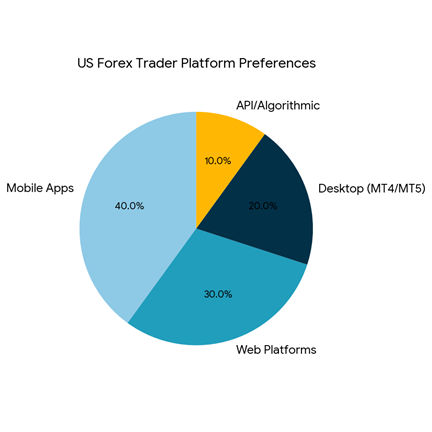
The chart below illustrates the shifting preferences in trading platforms among US retail forex traders in 2026.
4. Customer Service and Support
The forex market is open 24 hours a day, 5 days a week. If you have an open position and your internet drops, or you experience a platform glitch, you need to be able to reach a human being immediately. Test a broker’s customer service before depositing funds. Jump into their live chat or call their support line to see how quickly they respond and how knowledgeable their staff is.
5. Execution Speed and Slippage
For algorithmic traders and scalpers, execution speed is paramount. You want a broker that can execute your market orders in milliseconds with minimal slippage (the difference between the expected price of a trade and the price at which the trade is actually executed). Brokers like Interactive Brokers and FOREX.com publish their execution statistics, providing transparency into their trade routing efficiency.
The Future of US Forex Trading in 2026 and Beyond
The US retail forex market has stabilized significantly. After the mass exodus of brokers following the Dodd-Frank act over a decade ago, the firms that remained have built incredibly robust, heavily capitalized businesses.
In 2026, we are seeing a major shift toward behavioral analytics and AI-driven trading assistance. Brokers are no longer just providing access to the market; they are actively trying to help their clients become better traders by providing deep, algorithmic insights into their trading habits. We are also seeing the absolute dominance of TradingView as the front-end charting interface of choice, forcing legacy platforms to adapt or die.
Conclusion
Trading forex in the United States requires navigating a strict regulatory environment, but that regulation exists to protect you. By choosing a CFTC and NFA regulated broker like tastyfx, FOREX.com, OANDA, Interactive Brokers, or Charles Schwab, you ensure your funds are safe and your trades are executed fairly.
Take the time to open demo accounts with a few of these brokers. Test their platforms, analyze their spreads during the trading sessions you plan to be active, and choose the partner that best aligns with your financial goals and trading style.