
1. Forex Spreads
The most common and visible cost of trading Forex is the spread. In simple terms, a spread is the difference between the bid (sell) price and the ask (buy) price of a currency pair.
Whenever you look at a Forex quote, you will see two prices. The bid price is always slightly lower than the ask price. The broker keeps this difference as compensation for executing your trade. Spreads are measured in ‘pips’ (percentage in point), which represents the smallest price move that a given exchange rate makes.
Forex brokers typically offer either fixed spreads or variable (floating) spreads:
• Fixed Spreads: The spread remains constant regardless of market conditions. This provides predictability, but fixed spreads are often wider than variable ones.
• Variable Spreads: The spread fluctuates based on market liquidity and volatility. During major news events, variable spreads can widen significantly, increasing your trading costs.
Practical EUR/USD Example:
Imagine the EUR/USD pair has a bid price of 1.1050 and an ask price of 1.1052. The spread here is 2 pips. If you buy EUR/USD at 1.1052 and immediately sell it without the market moving, you would sell at 1.1050, instantly losing the 2-pip equivalent in cash. Therefore, your trade must move in your favor by at least the spread distance just to break even.
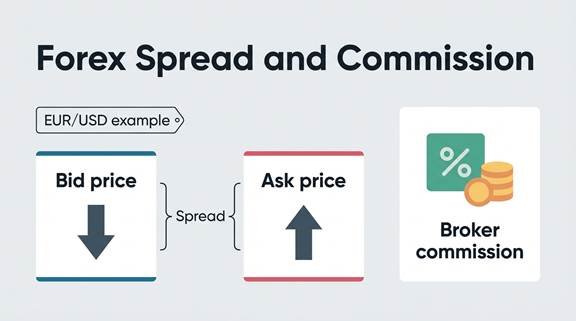
Caption: The spread is the fundamental cost of trading, representing the gap between the bid and ask price.
Alt-Text: Infographic explaining Forex spreads with a EUR/USD bid and ask price example.
2. Forex Trading Commissions
While some brokers incorporate their entire fee into the spread, others offer Raw or ECN (Electronic Communication Network) accounts. These accounts provide direct market access with extremely tight spreads (sometimes as low as 0.0 pips), but they charge a fixed Forex trading commission per trade.
Understanding Commission Structures:
• Commission-Free Accounts: No separate commission is charged, but the broker widens the spread. This is usually best for beginners or swing traders who do not trade frequently.
• Commission-Based Accounts: Traders get the tightest possible market spreads but pay a flat fee per lot (100,000 units of currency) traded. This structure is preferred by scalpers and high-volume day traders.
Commissions are generally charged on a round-turn basis. A round-turn means opening and closing the trade. For example, if your broker charges $3.50 per lot per side (one-way), your total round-turn commission for trading one standard lot will be $7.00. This is a fixed, transparent cost that you must deduct from your gross profit.
3. Overnight Financing Fees (Swap Fees)
If you are a day trader who closes all positions before the market closes, you won’t encounter overnight financing fees. However, if you hold a trade overnight, you will incur Forex swap fees (also known as rollover charges).
Forex trading always involves borrowing one currency to buy another. Therefore, overnight fees are determined by the interest-rate differential between the two currencies in the pair you are trading. Central bank interest rates dictate these costs.
• Long Position (Buying): If you buy a currency with a higher interest rate than the currency you are borrowing to fund the trade, you might actually receive a positive swap (the broker pays you).
• Short Position (Selling): If you buy a currency with a lower interest rate than the borrowed currency, your account will be charged a negative swap fee.
Because brokers also add a small markup to the swap rate, it is far more common to pay swap fees than to receive them. Holding a trade for weeks or months can result in significant overnight financing fees, which can severely reduce long-term profitability.
4. Currency Conversion Fees
Many traders overlook currency conversion fees until they see unexplained deductions in their account balance. These charges occur when you trade a currency pair, make a deposit, or request a withdrawal in a currency different from your account’s base currency.
For example, if your Forex trading account is denominated in US Dollars (USD), but you decide to trade the EUR/GBP pair, your profits or losses are realized in British Pounds (GBP). The broker must instantly convert those GBP profits or losses back into USD. Brokers typically apply a currency conversion fee or add a markup to the exchange rate used for this transaction, which subtly increases your overall trading costs.
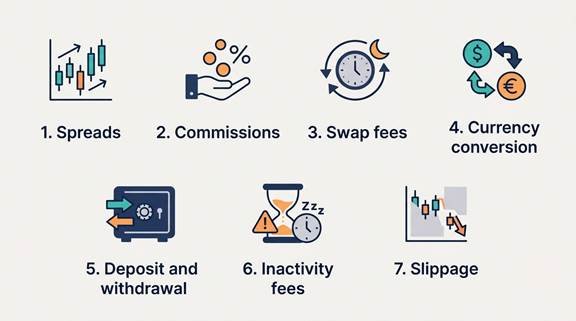
Caption: The 7 fundamental costs every Forex trader must factor into their risk management strategy.
Alt-Text: Infographic detailing the seven primary costs of trading Forex in 2026.
5. Deposit and Withdrawal Fees
Moving money in and out of your trading account can also trigger fees. While the industry standard in 2026 leans toward free deposits, withdrawals often carry a price tag.
• Bank Wire Transfers: These are notorious for high fees. Your broker might charge $15 to $30 for an international wire withdrawal, and intermediary banks may deduct further fees.
• Credit/Debit Cards: Usually free for deposits, but some brokers limit withdrawals to the initial deposit amount, forcing you to use wire transfers for your profits.
• E-Wallets: Payment processors like PayPal, Skrill, or Neteller often provide fast transactions, but the third-party processor may charge a percentage fee (e.g., 1% to 3%) on incoming or outgoing funds.
Always check the broker’s specific withdrawal policies and payment provider terms to avoid losing a chunk of your profits just to access your money.
6. Inactivity Fees
If you take a break from trading, your broker might penalize you. Inactivity fees are monthly charges deducted from dormant accounts. An account is typically deemed “inactive” if no trades have been placed for a specified period—usually 6 to 12 months.
These fees can range from $10 to $50 per month. Fortunately, inactivity fees are easily avoidable. You simply need to place a minimal trade, or better yet, withdraw your funds if you plan to stop trading for an extended period.
7. Slippage and Execution Costs
Slippage is an indirect trading cost that occurs when a trade is executed at a different price than requested. This happens most often during periods of high market volatility (like a major news release) or low market liquidity.
• Negative Slippage: You attempt to buy at 1.1050, but the market moves too fast, and your order gets filled at 1.1055. This 5-pip difference acts as a hidden cost.
• Positive Slippage: The market moves in your favor during execution, getting you a better price than requested (this is rare but possible).
Execution speed heavily influences slippage. Choosing a reputable broker with top-tier server infrastructure can minimize these indirect costs.
How Much Does Forex Trading Really Cost?
To understand how these fees interact, let’s look at a hypothetical 1-lot (100,000 units) EUR/USD trade held for three days on a commission-based account. (Note: These are illustrative figures, not current broker rates).
| Fee Type | Estimated Cost (Hypothetical) |
| Spread (0.2 pips) | $2.00 |
| Round-turn Commission | $7.00 |
| Swap Fee (held 3 nights) | $4.50 |
| Total Trading Cost | $13.50 |
In this scenario, the trade costs $13.50 in total fees. If the market does not move, your account balance will show a $13.50 loss. You must generate more than $13.50 in gross profit for this trade to be genuinely profitable.
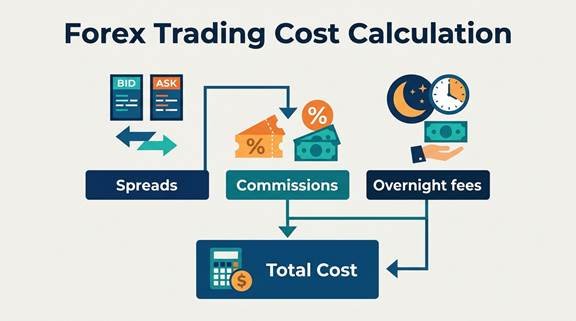
Caption: A breakdown of how individual fees combine to create the total cost of a hypothetical Forex trade.
Alt-Text: Table graphic showing spreads, commissions, and overnight fees calculation.
How to Reduce Forex Trading Costs
While you cannot eliminate fees entirely, you can manage and minimize them. Here are practical tips to reduce your Forex broker fees:
• Compare spreads across regulated brokers: Ensure you are getting competitive rates for the specific currency pairs you trade most often.
• Understand commission structures: If you are a high-frequency trader, a raw spread account with a flat commission is usually cheaper than a standard account with wide spreads.
• Check overnight financing rates: If you swing trade, compare swap rates. Avoid holding trades overnight unnecessarily if the negative swap is exceptionally high.
• Avoid unnecessary trades: Overtrading is the fastest way to rack up commissions and spread costs.
• Review deposit and withdrawal policies: Opt for funding methods that do not incur transaction fees.
• Choose an account that suits your strategy: Don’t pay for premium ECN execution if you only trade small positions once a week.
• Read the complete fee schedule: Always review the broker’s official terms and conditions for hidden costs like inactivity or currency conversion fees.
How to Compare Forex Broker Fees in 2026
When comparing Forex brokers in 2026, transparency is key. Do not open an account based on marketing slogans. Instead, compare these specific metrics:
1. Average Spreads: Look for the ‘average spread’ during active trading hours, not just the ‘minimum spread’ which may rarely be available.
2. Commission Per Lot: Compare round-turn commissions across ECN-style accounts.
3. Overnight Financing: Check the swap rates on the broker’s platform for your preferred assets.
4. Minimum Deposits: Ensure the minimum funding requirement aligns with your budget.
5. Withdrawal Charges: Look for brokers that offer at least one free withdrawal method per month.
6. Regulatory Status: Always choose brokers regulated by top-tier authorities (like the FCA, CFTC, or NFA). A regulated broker is required to maintain transparent fee structures.
Frequently Asked Questions
1. What are the main fees in Forex trading?
The primary costs are spreads (the bid/ask difference), trading commissions, overnight financing (swap fees), and potential deposit, withdrawal, or currency conversion fees.
2. Is Forex trading commission-free?
Some accounts are advertised as commission-free, but this simply means the broker’s fee is built entirely into a wider spread. There is always a cost to trade.
3. How much does a Forex broker charge per trade?
It varies widely. Standard accounts might charge 1-2 pips (built into the spread), while raw accounts might charge a $5 to $7 round-turn commission per standard lot, plus a fractional spread.
4. What is the difference between spread and commission?
The spread is a dynamic cost based on the price difference between buying and selling a currency pair. A commission is a fixed flat fee charged per lot traded.
5. Do Forex brokers charge overnight fees?
Yes, if you hold a position past 5:00 PM EST, you will either pay or earn an overnight financing fee (swap), depending on the interest rate differences of the traded currencies.
6. Can I trade Forex without paying fees?
No. Brokers provide the platform, liquidity, and market access. In exchange, they must charge spreads or commissions to sustain their business.
7. How can beginners reduce Forex trading costs?
Beginners can reduce costs by choosing standard accounts with tight spreads, avoiding overtrading, closing trades before the daily rollover to avoid swap fees, and using free withdrawal methods.