

Payday feels incredible for about forty-eight hours. Your bank balance looks healthy, your stress levels drop, and grabbing takeout or ordering that thing sitting in your online shopping cart feels completely harmless. Then the first of the month hits. The rent or mortgage clears, the electricity and internet bills chime in, a grocery trip costs way more than you planned, and suddenly you are staring at your banking app wondering how your hard-earned paycheck evaporated in less than a week.
If you have ever felt like you make decent money on paper yet still scramble during the final week of the month, the problem usually isn’t your willpower—it is your lack of a system. Most people treat their bank account like one giant communal pot of soup. Every bill, impulse buy, grocery trip, and savings goal gets ladle-scooped out of the exact same balance until the pot runs dry.
The secret to breaking the paycheck-to-paycheck cycle is dividing your income by percentage before you spend a single dollar. When you assign every portion of your income a clear job on payday, you never have to agonize over whether you can afford a dinner out with friends, and you never accidentally spend next month’s car insurance money.
Step 1: Calculate Your True Take-Home Pay
Before you can slice up the pie, you need to know exactly how big the pie actually is. One of the biggest budgeting mistakes beginners make is calculating their lifestyle around their gross income (the big salary number on your job offer letter) instead of their net income (the actual cash that lands in your checking account).
To find your true monthly baseline, open your last two months of bank statements and look strictly at the deposits:
- If you are paid monthly: Your net deposit is your baseline number. If your employer automatically deducts health insurance, taxes, or a retirement contribution before paying you, leave those out of your manual calculations—focus on the net cash you control.
- If you are paid bi-weekly (every two weeks): Multiply a single paycheck by 26 and divide by 12 to find your true monthly average. Better yet, build your monthly budget using just two paychecks per month. Because there are 26 bi-weekly pay periods in a year, two months out of the year will hand you a “third” bonus paycheck that you can send straight toward debt payoff, vacations, or investments.
- If you are a freelancer, commission earner, or business owner: Look at your past 12 months of earnings and find your three lowest-earning months. Average those three numbers together and build your monthly expense division around that conservative figure. During booming months, sweep every dollar above that baseline straight into a buffer account and long-term savings.
Step 2: Master the Gold Standard (The 50/30/20 Rule)
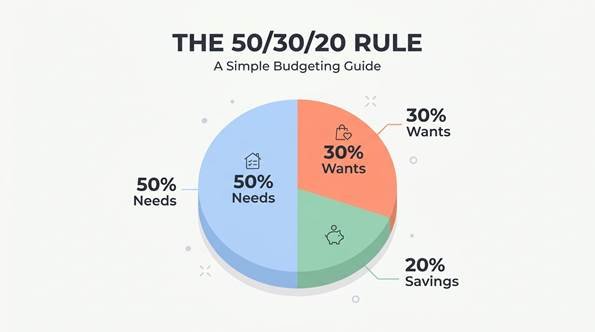
If you have ever quit a budget after two weeks because tracking twenty-five micro-categories in a spreadsheet felt like an unpaid part-time job, the 50/30/20 rule is your best friend. Popularized by Senator Elizabeth Warren and her daughter Amelia Warren Tyagi in their book All Your Worth, this framework divides your after-tax income into just three straightforward buckets.
Bucket 1: 50% for Needs (Your Non-Negotiable Foundation)
Half of your take-home pay is reserved for the expenses required to keep a roof over your head, food on your table, and your ability to earn a living intact. If skipping a bill would wreck your credit score, leave you without electricity, or jeopardize your job, it belongs in Needs:
- Housing: Rent or mortgage payments, property taxes, and basic home or renters insurance.
- Utilities: Electricity, water, heating, trash, and basic home internet needed for work.
- Basic Groceries: Supermarket staples and household toiletries (note: fancy artisanal snacks and Friday night pizza delivery do not count as basic groceries).
- Transportation: Car payments, auto insurance, fuel, basic maintenance, or monthly public transit passes.
- Healthcare & Minimum Debt: Health insurance premiums, essential prescriptions, and the minimum required payments on student loans or credit cards.
Bucket 2: 30% for Wants (Guilt-Free Lifestyle)
Budgets fail for the exact same reason crash diets fail: total deprivation always backfires. The 30% Wants bucket exists so you can enjoy your life today while still building for tomorrow. Wants include anything that upgrades your comfort or entertainment:
- Dining & Socializing: Restaurants, coffee shop runs, takeout, and weekend outings.
- Subscriptions & Entertainment: Netflix, Spotify, gym memberships, gaming, concerts, and hobbies.
- Upgrades: Buying a designer coat when a basic jacket works fine, upgrading to the newest smartphone, or choosing a luxury apartment over a modest one.
- Travel & Shopping: Weekend getaways, home decor, clothing hauls, and personal care treats.
Bucket 3: 20% for Savings & Debt Crushing (Your Future Freedom)
The final 20% of your paycheck goes straight to “Future You.” This bucket is where financial anxiety disappears and real wealth begins:
- Emergency Fund: Your first priority is building 3 to 6 months of essential living expenses in an easily accessible savings account so a flat tire or medical bill never forces you into credit card debt.
- High-Interest Debt Payoff: Any extra payments above the minimum requirement on credit cards or personal loans come out of this 20% bucket to wipe out interest charges fast.
- Long-Term Investing & Big Goals: Retirement contributions, index funds, a house down payment fund, or education savings.
Step 3: Choose an Alternative Split When 50/30/20 Doesn’t Fit
While 50/30/20 is a brilliant benchmark, rising rents and grocery prices mean keeping essentials under 50% isn’t realistic for everyone. Never abandon budgeting just because your rent is high—simply adjust the dial to match your current season of life:
| Budgeting Framework | Needs Split | Wants Split | Savings & Debt | Who Should Use This Split |
| 50/30/20 Rule | 50% | 30% | 20% | Steady earners with moderate housing costs |
| 60/20/20 Rule | 60% | 20% | 20% | High-cost-of-living city dwellers or young families |
| 70/20/10 Rule | 70% | 20% | 10% | Entry-level earners or aggressive debt-payoff sprints |
| 80/20 Rule | 80% (Combined) | Included in 80% | 20% | Busy professionals who hate tracking categories |
| 50/15/35 FIRE Split | 50% | 15% | 35% | High earners aiming for early financial independence |
- The 60/20/20 Realistic City Split: If housing and groceries consume 60% of your pay, don’t raid your savings bucket to cover the gap. Keep your savings locked at 20% and trim your Wants bucket from 30% down to 20%.
- The 70/20/10 Starter Split: When starting out on an entry-level income, essentials might eat up 70% of your pay. Dedicate 20% to enjoying life and 10% to building your starter emergency fund (or flip them—20% to debt/savings and 10% to fun—if you want to break out of debt faster).
- The 80/20 “Anti-Budget”: If separating Needs from Wants makes your head spin, automate 20% of every paycheck into savings and investments on payday, then spend the remaining 80% on your bills and lifestyle with zero category tracking.
Step 4: Real-World Math at Three Different Income Levels
Seeing exact dollar figures makes setting up your bank transfers effortless. Compare how the 50/30/20 split vs. the 60/20/20 split looks across three common monthly take-home incomes:
- On a $2,000 Monthly Net Income: Under 50/30/20, you allocate $1,000 to Needs, $600 to Wants, and $400 to Savings. Under 60/20/20, you allocate $1,200 to Needs, $400 to Wants, and $400 to Savings.
- On a $3,500 Monthly Net Income: Under 50/30/20, you allocate $1,750 to Needs, $1,050 to Wants, and $700 to Savings. Under 60/20/20, you allocate $2,100 to Needs, $700 to Wants, and $700 to Savings.
- On a $5,000 Monthly Net Income: Under 50/30/20, you allocate $2,500 to Needs, $1,500 to Wants, and $1,000 to Savings. Under 60/20/20, you allocate $3,000 to Needs, $1,000 to Wants, and $1,000 to Savings.
Step 5: Set Up the “Three-Bucket” Bank System to Automate Everything

Willpower is a terrible financial strategy. If you rely on yourself to manually calculate percentages every time you swipe your debit card at the grocery store, you will burn out by mid-month. Instead, build a Three-Account Firewall that divides your income automatically within 24 hours of payday:
1. Account 1: The Bills Checking Account (Needs): Have your paycheck deposited here (or transfer your 50%–60% Needs share here on payday). Put every single fixed bill—rent, utilities, internet, insurance, minimum loan payments—on autopay out of this account. Never carry the debit card for this account in your wallet so you cannot accidentally swipe your rent money at a restaurant.
2. Account 2: The High-Yield Savings Account (Savings & Sinking Funds): Set an automatic recurring transfer for the day after payday that moves your 20% savings portion straight into an online High-Yield Savings Account (HYSA) at a separate bank. Keeping this money slightly out of reach prevents midnight impulse transfers while earning 10x more interest than a standard brick-and-mortar bank.
3. Account 3: The Guilt-Free Spending Account (Wants): Set an automatic transfer for your 20%–30% Wants allowance into a second checking account, and keep this debit card in your wallet and linked to your phone. Whether you have $400 or $5 left in this account on the 25th of the month, you know at a single glance exactly how much fun money remains without ever jeopardizing your bills or your savings.
Step 6: Don’t Let “Surprise” Annual Expenses Wreck Your Split
Even the cleanest 50/30/20 budget can get ambushed by expenses that don’t show up every month—like annual car registration, holiday gifts, weddings, back-to-school shopping, or a six-month auto insurance premium. Financial pros call these Sinking Funds.
Instead of letting a $600 annual car insurance bill blow up your budget in November, divide $600 by 12 months and include that $50 monthly transfer inside your Needs or Wants bucket all year long. Many modern online banks let you create digital sub-buckets inside your savings account labeled “Car Repairs,” “Holidays,” and “Vacation” so the cash is sitting ready and waiting the moment the bill arrives.
Dividing your income isn’t about restricting your life—it is about giving yourself permission to spend your fun money with zero guilt because your bills are covered and your future is already paid for. Pick the ratio that fits your life today, set up your automatic payday transfers this week, and watch how quickly financial stress gets replaced by total clarity.